Digital vs Analog Dimming: The Complete Guide to Choosing the Right LED Control Method
Whether you’re an electrical engineer, lighting designer, or a homeowner upgrading your smart home, understanding the difference between digital and analog dimming is critical. The type of dimming technology you use directly affects light quality, energy efficiency, color accuracy, flicker sensitivity, and the overall lifespan of your LED fixtures.
In this comprehensive guide, we break down digital dimming vs analog dimming in plain language — covering the science behind each method, real-world performance comparisons, pros and cons, and expert recommendations for every use case.
By the end of this article, you will know:
- How analog (CCR) dimming works and when to use it
- How digital (PWM) dimming works and why it dominates the market
- The flicker problem — and which method solves it
- Which dimming type is best for photography, retail, medical, and residential lighting
- How hybrid dimming combines both worlds
What Is Dimming in LED Lighting?
LED dimming refers to the process of reducing an LED’s brightness output below its maximum level. Unlike traditional incandescent bulbs — which dim simply by reducing current — LEDs require precise control because they are current-driven devices. Feed them too little current and they can become unstable, flicker, or shift color temperature.
There are two primary dimming philosophies: analog dimming (also called Constant Current Reduction or CCR) and digital dimming (also called Pulse Width Modulation or PWM). Each controls the light output in a fundamentally different way, and the choice between them has significant downstream consequences.
Analog Dimming Explained: Constant Current Reduction (CCR)
How Analog Dimming Works
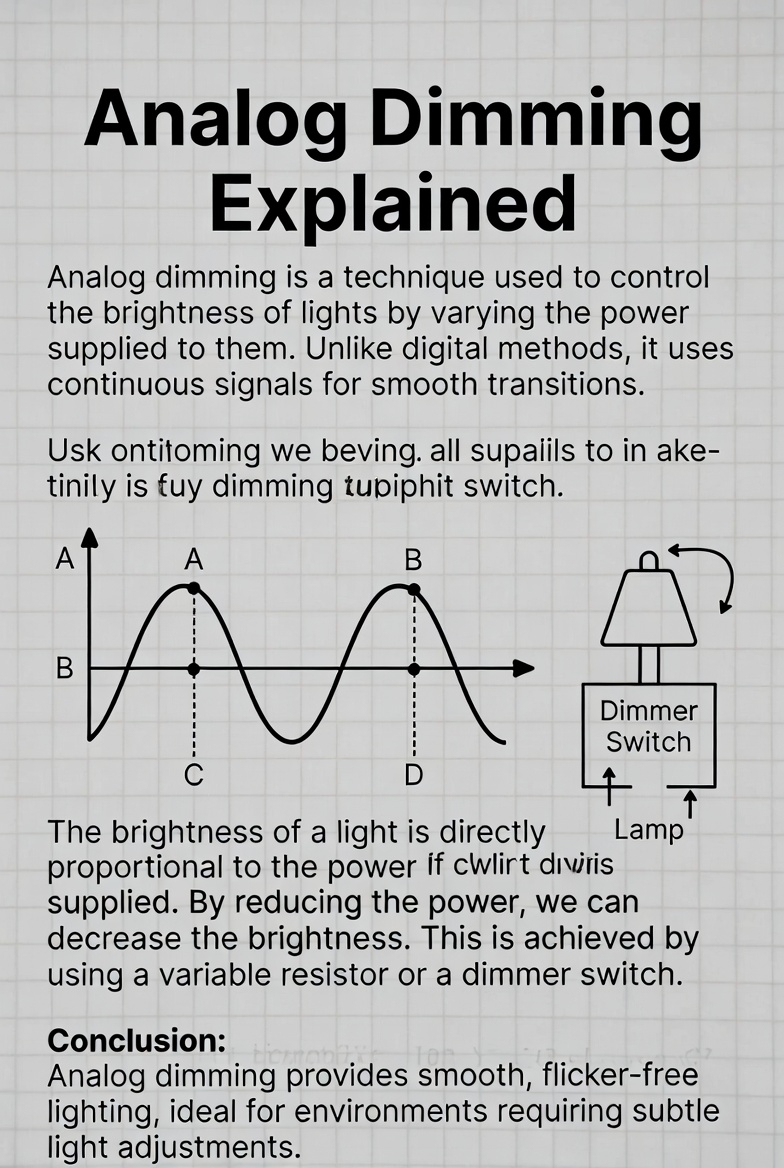
Analog dimming — or CCR dimming — works by continuously and smoothly reducing the electrical current flowing through the LED. Think of it like a water faucet: you simply turn the handle to reduce the flow. The LED is always ‘on,’ but it receives less power, so it glows less brightly.
In practice, an analog LED driver accepts a 0–10V control signal (or a DALI or 1–10V signal) and proportionally scales the drive current from 100% down to a set minimum — typically around 10–20% of full brightness.
Advantages of Analog Dimming
- Zero flicker: Because the LED is always powered (never switching on and off), analog dimming produces absolutely no flicker — making it ideal for sensitive environments.
- Superior color stability: At lower drive currents, high-quality LEDs maintain excellent color rendering index (CRI) and color temperature consistency.
- Simple implementation: A basic 0–10V analog control signal is straightforward to implement with widely available hardware.
- Electromagnetic compatibility: Analog dimming generates no high-frequency switching noise, which can interfere with audio equipment, sensitive electronics, or RF devices.
Disadvantages of Analog Dimming
- Limited dim range: As current drops below ~10–15%, many LEDs become unstable. Deep dimming below 5% is often not achievable with analog methods.
- Color shift at low levels: Some LEDs — especially lower-binned phosphor-converted white LEDs — shift warmer or cooler as current decreases. This is a physical property of certain phosphor compositions.
- Less efficient at very low levels: The power saved is proportional to current reduction, but driver inefficiency can erode gains at the low end of the dimming curve.
Digital Dimming Explained: Pulse Width Modulation (PWM)
How PWM Dimming Works
Digital dimming — or PWM dimming — works on an entirely different principle. Rather than reducing current, PWM keeps the LED operating at full power but rapidly switches it on and off. The ratio of ‘on time’ to ‘off time’ is called the duty cycle, and it is this duty cycle that determines perceived brightness.
For example, a 50% duty cycle means the LED is on for half the time and off for half the time. Our eyes — and brain — integrate these rapid flashes and perceive them as steady, dimmer light. At 1,000 Hz (1,000 on-off cycles per second), most people cannot consciously detect the flicker. However, that doesn’t mean it doesn’t exist — and this is where PWM dimming gets controversial.
Advantages of PWM (Digital) Dimming
- Extremely wide dimming range: PWM can theoretically dim LEDs to less than 0.1% brightness by reducing the duty cycle to a very small pulse — something CCR cannot achieve.
- Consistent color throughout: Because the LED always runs at full rated current when ‘on’, its color point never shifts. You get the same warm white at 10% as at 100%.
- Better driver efficiency: PWM drivers can maintain high efficiency even at low brightness levels because the LED operates at full power when on.
- Precise control and compatibility: PWM signals are highly compatible with microcontrollers, digital control systems (DALI, DMX512, Bluetooth), and smart home ecosystems.
- Scalability: PWM is easily extended to multi-channel RGBW and tunable white systems, enabling complex dynamic lighting scenes.
Disadvantages of PWM (Digital) Dimming
- Flicker risk: At lower PWM frequencies (below 1,000 Hz), flicker becomes visible or physiologically perceptible to sensitive individuals — causing headaches, eye strain, and discomfort in up to 30% of the population.
- Electromagnetic interference (EMI): The rapid on-off switching creates high-frequency noise that can interfere with nearby electronics, microphones, and radios if not properly filtered.
- Stroboscopic effects: Under PWM-dimmed lighting, fast-moving objects (fans, machinery, athletes) can appear to ‘freeze’ or jump — a stroboscopic effect that poses safety hazards in industrial environments.
- Complexity: Designing a robust PWM system with appropriate frequency, duty cycle resolution, and EMI shielding requires more engineering knowledge and hardware investment.
Digital vs Analog Dimming: Head-to-Head Comparison
The table below summarizes the key differences at a glance:
| Feature | Analog Dimming | Digital Dimming (PWM) | Hybrid Dimming |
| Color Accuracy | Excellent | Good–Excellent | Excellent |
| Flicker Risk | None | Possible at low Hz | Very Low |
| Dimming Range | Moderate | Very Wide | Wide |
| Heat Generation | Higher | Lower | Low |
| Cost | Lower | Moderate | Higher |
| Best For | Photography, Studios | General LED, Displays | Premium & Medical |
The Flicker Problem: Why It Matters More Than You Think
Flicker is one of the most misunderstood and underappreciated factors in lighting design. The IEEE 1789-2015 standard classifies flicker risk by frequency and modulation depth. Lighting that flickers faster than 1,250 Hz at modulation depths below 0.025% is generally considered safe for most people.
However, studies published in journals such as Lighting Research & Technology have shown that even imperceptible flicker — below the threshold of visual awareness — can trigger migraines in photosensitive individuals, cause eyestrain during prolonged exposure, reduce visual task performance, and induce behavioral changes in children with certain neurological conditions.
The key takeaway: When flicker health is a priority — such as in schools, hospitals, offices, or photography studios — analog dimming (CCR) is the safer, more reliable choice. When flicker is managed with high-frequency PWM (above 3,000 Hz), digital dimming performs comparably.
Which Dimming Method Is Best for Your Application?
Residential and Smart Home Lighting
For the typical homeowner, PWM dimming at 3,000 Hz or above — as found in most quality smart LED bulbs and drivers — is perfectly adequate. Most smart home ecosystems (Philips Hue, Lutron Caseta, LIFX) use high-frequency PWM that poses negligible flicker risk. If you or a family member suffers from migraines or photosensitivity, however, specify analog dimming or ‘flicker-free’ rated products.
Photography and Video Studios
This is the most critical application where analog dimming wins decisively. Camera sensors have electronic shutters that can interact with PWM flicker — producing banding artifacts in photos and rolling shutter effects in video. Even at 3,000 Hz, some high-speed camera sensors will capture flicker. Professional photographic LED panels and studio lights almost universally use analog (CCR) dimming or very high-frequency PWM (above 10,000 Hz) for this reason.
Retail and Hospitality Lighting
Color rendering is paramount in retail — especially for fashion, jewelry, and food. Analog dimming preserves color accuracy throughout the dimming range. For dynamic accent lighting scenes, high-frequency PWM with RGBW control offers more creative flexibility. Many top-tier retail lighting projects use hybrid systems: CCR for ambient lighting and high-frequency PWM for accent and display lighting.
Medical and Healthcare Facilities
Healthcare environments demand zero-flicker lighting due to the high risk of photosensitive patients, operating theatre cameras, and imaging equipment interference. The Human Centric Lighting (HCL) movement in medical design strongly advocates for analog dimming or hybrid solutions certified to IEC/EN 62717 standards for flicker compliance.
Industrial and Warehouse Lighting
PWM stroboscopic effects pose genuine safety hazards near rotating machinery. Industrial lighting codes in many jurisdictions prohibit dimmed lighting near lathes, mills, and conveyor systems unless the stroboscopic effect is provably absent. Here, analog dimming is the only safe choice for dimmed fixtures near moving equipment, while PWM at very high frequency (>10 kHz) may be permissible for general ambient lighting.
Horticulture and Grow Lighting
Plant photobiology is sensitive to light cycles at certain frequencies. Early research suggests that very low-frequency PWM (<100 Hz) may affect photosynthesis rates and circadian rhythm entrainment in plants. High-frequency PWM above 1,000 Hz or analog dimming is recommended for commercial horticultural LED systems.
Hybrid Dimming: The Best of Both Worlds?
Many modern premium LED drivers now incorporate hybrid dimming — combining analog current reduction with PWM control. The strategy is simple: at higher brightness levels (say, 20–100%), the driver uses analog CCR for flicker-free, color-stable performance. As brightness drops below 20%, where analog dimming becomes unstable, the driver switches to PWM at a very high frequency to maintain the deep dimming range.
This hybrid approach effectively eliminates the key weaknesses of both methods: no color shift at mid-levels, no flicker risk, and deep dimming capability down to 0.1% or less. Brands such as Tridonic, Osram, and Inventronics offer hybrid-capable DALI and 0–10V LED drivers in the professional market.
The trade-off is cost and complexity. Hybrid drivers are typically 15–30% more expensive than single-method equivalents, and configuring the crossover point and PWM frequency requires technical expertise.
Key Standards and Certifications to Know
- IEEE 1789-2015: The definitive standard for acceptable LED flicker limits by frequency and modulation depth.
- IEC/EN 62717: European standard for LED module performance including flicker and stroboscopic effect metrics.
- California Title 24 (2022): Mandates flicker compliance for dimmed lighting in California building projects — a benchmark often followed globally.
- UL 8750: Safety standard for LED equipment covering electrical performance of drivers and dimming systems.
- DALI (IEC 62386): Digital Addressable Lighting Interface — a universal digital control protocol compatible with both PWM and hybrid dimming systems.
- ENERGY STAR: Requires luminaires to meet minimum flicker performance thresholds at all dimming levels.
Frequently Asked Questions (FAQ)
Q: Is PWM dimming bad for your eyes? Not necessarily. The risk depends entirely on the PWM frequency. Frequencies above 3,000 Hz are generally considered safe for most people. However, photosensitive individuals may still experience issues, and analog dimming is the medically conservative choice.
Q: Can I use an analog dimmer switch with LED bulbs? It depends. Standard phase-cut (TRIAC) wall dimmers are not compatible with all LED drivers. You need an LED-compatible dimmer rated for the LED load. Some advanced 0–10V dimmers are truly analog-compatible for driver-level control.
Q: What is 0–10V dimming? 0–10V dimming is a widespread analog control method. A 0–10V control voltage sent from a wall controller to the LED driver scales the output from 100% (at 10V) to minimum (at 0V or 1V, depending on driver design). It is one of the most common implementations of analog dimming in commercial lighting.
Q: Does PWM dimming reduce energy consumption? Yes. While the LED itself runs at full current during its ‘on’ pulses, the overall average power consumption drops proportionally to the duty cycle. A 50% duty cycle uses approximately 50% of the energy of continuous full-power operation.
Q: Which is better for RGBW tunable white systems? PWM is the dominant choice for multi-channel LED systems because it enables precise individual channel control while maintaining consistent color at full drive current. Many high-end RGBW fixtures use 20,000+ Hz PWM to eliminate any perceptible flicker.
Conclusion: Digital vs Analog Dimming — Which Should You Choose?
Both analog and digital dimming are mature, valid technologies — and the right choice depends entirely on your application, priorities, and budget.
- Choose analog (CCR) dimming if flicker health, electromagnetic compatibility, photography compatibility, or industrial safety near rotating machinery are priorities.
- Choose digital (PWM) dimming if you need a wide dimming range, precise digital control, RGBW multi-channel capability, or smart home integration — and you specify a PWM frequency above 3,000 Hz.
- Choose hybrid dimming for premium installations where you demand both deep dimming range and flicker-free performance without compromise.