

Choosing the right lighting and building control protocol is one of the most consequential decisions you will make during a construction or renovation project. Get it right, and your building will be energy-efficient, flexible, and easy to manage for decades. Get it wrong, and you could face costly retrofits, vendor lock-in, and systems that simply do not talk to each other. Three protocols dominate the professional market today: DALI, Zigbee, and KNX. Each has its own strengths, weaknesses, and ideal use cases. In this comprehensive guide, we break down everything you need to know about DALI vs Zigbee vs KNX so you can make the best decision for your specific project.
What Is DALI (Digital Addressable Lighting Interface)?
DALI stands for Digital Addressable Lighting Interface. It is an internationally recognised standard (IEC 62386) developed specifically for lighting control. Unlike older analogue 0-10V systems, DALI uses a two-wire digital bus that allows two-way communication between a controller and individual lighting devices such as LED drivers, ballasts, and dimmers.
Each DALI segment supports up to 64 individually addressable devices, and up to 16 groups and 16 scenes can be created per segment. Because it is a true two-way protocol, a DALI controller can query the actual status of every luminaire on the bus, enabling real-time fault detection and energy reporting. The DALI-2 standard, introduced by the DALI Alliance, further tightened interoperability requirements between devices from different manufacturers, making multi-vendor installations far more reliable.
Key Features of DALI
- Purpose-built for lighting control with precise dimming curves
- Individual device addressing – up to 64 devices per segment
- Two-way communication: status feedback, fault reporting, energy metering
- DALI-2 certification ensures cross-manufacturer compatibility
- Simple two-wire bus, polarity-insensitive wiring
- Supports emergency lighting (DALI Part 202 and Part 301)
Pros and Cons of DALI
The biggest advantage of DALI is its precision and reliability. It is the go-to standard in commercial lighting for a reason. Architects and lighting designers rely on DALI for complex scene setting, daylight harvesting, and circadian lighting programmes. Because the protocol is lighting-specific, driver manufacturers have optimised their products to deliver incredibly smooth dimming, often from 100% down to 0.1%.
The main limitation of DALI is its narrow scope. It controls luminaires and little else. If you need to integrate HVAC, blinds, occupancy sensors, or access control, you will need a gateway or a higher-level building management system (BMS) to bridge the gap. Additionally, the 64-device limit per segment means that large installations require multiple DALI lines and a competent controller to manage them.
What Is Zigbee?
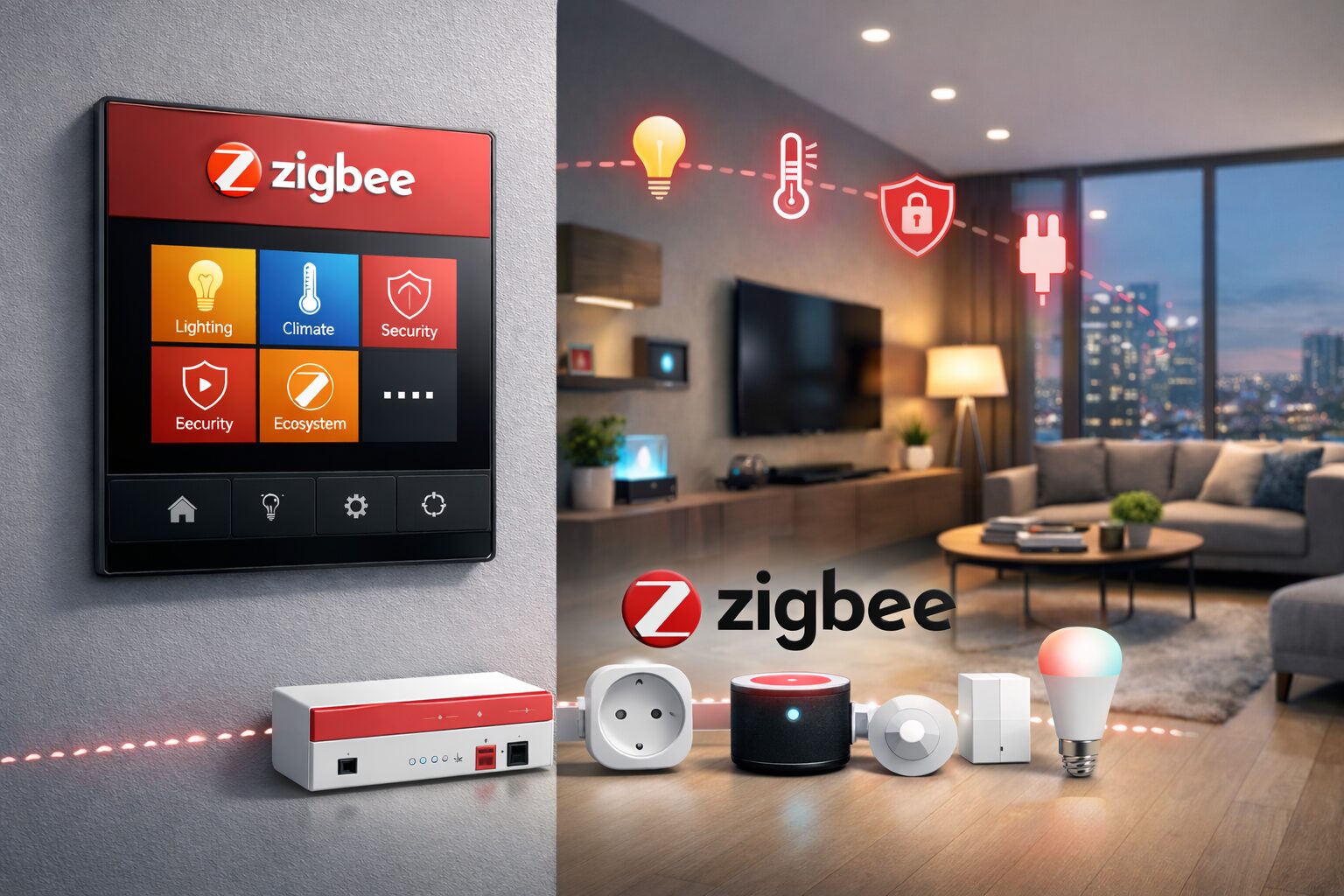
Zigbee is a low-power, wireless mesh networking protocol based on the IEEE 802.15.4 standard. Developed by the Zigbee Alliance (now the Connectivity Standards Alliance), it operates primarily in the 2.4 GHz frequency band and is designed for low-data-rate IoT applications. Unlike DALI and KNX, Zigbee is entirely wireless, making it a popular choice for retrofits and smart home installations where pulling new cables is impractical or prohibitively expensive.
In a Zigbee mesh network, devices act as routers and relay signals between one another, extending the network range without the need for additional infrastructure. A typical Zigbee network can support up to 65,000 nodes in theory, though practical installations are far smaller. Zigbee 3.0 unified previously fragmented application profiles (ZigBee Light Link, ZigBee Home Automation, etc.) into a single standard, which dramatically improved device interoperability across brands.
Key Features of Zigbee
- Fully wireless – no additional cabling required
- Mesh topology – devices route signals for each other
- Supports lighting, sensors, thermostats, locks, and more
- Very low power consumption – ideal for battery-operated sensors
- Large ecosystem: Philips Hue, IKEA TRADFRI, Amazon Echo, Samsung SmartThings
- Zigbee 3.0 improves cross-brand interoperability
Pros and Cons of Zigbee
Zigbee’s wireless nature is its killer feature. There is no need for a dedicated control cable, making it ideal for residential smart home projects and commercial retrofits. Setup is relatively straightforward compared to KNX, and a wide range of affordable devices are available from major consumer brands. For small to medium commercial projects, Zigbee can deliver surprisingly capable lighting scenes, scheduling, and sensor-based automation at a fraction of the cost of a wired system.
However, wireless protocols come with inherent trade-offs. Zigbee shares the 2.4 GHz band with Wi-Fi and Bluetooth, which can cause interference in dense environments. Network reliability depends heavily on device density – a sparse installation with few routers can suffer from dropped commands and unreliable behaviour. Zigbee also lacks the determinism of wired systems, meaning there can be unpredictable latency in large or congested networks. For mission-critical applications such as hospital lighting or stage lighting control, this is a significant concern.
What Is KNX?
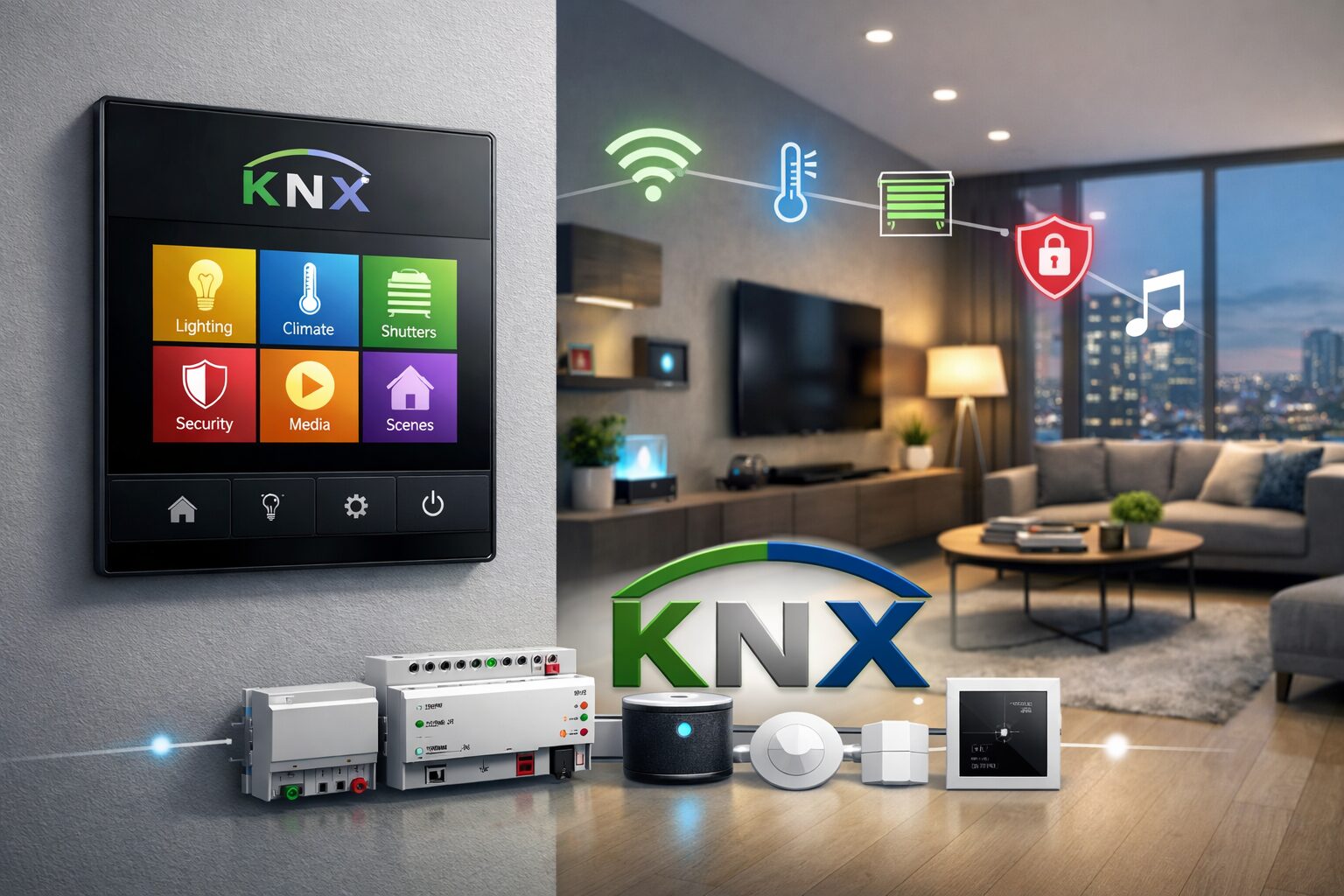
KNX is the world’s leading open standard for building automation and control (EN 50090, ISO/IEC 14543). Developed in the early 1990s through the merger of three European bus systems (EIB, BatiBUS, and EHS), KNX is today the gold standard for smart building control across Europe and increasingly worldwide. It is governed by the KNX Association, which certifies products from over 500 manufacturers and maintains a library of more than 8,000 certified devices.
Unlike DALI and Zigbee, KNX is designed to control every system within a building from a single, unified infrastructure. Lighting, HVAC, blinds and shading, energy management, security, access control, audio-visual systems, and fire safety can all be integrated on a single KNX installation. The most common physical medium is twisted pair (TP) cable, but KNX also supports powerline communication (PL), RF wireless, and IP backbone variants. KNX installations are programmed using the manufacturer-neutral ETS (Engineering Tool Software) provided by the KNX Association.
Key Features of KNX
- Whole-building automation: lighting, HVAC, blinds, energy, security, AV
- Open standard with over 500 certified manufacturers and 8,000+ products
- Highly scalable – supports thousands of devices per installation
- Deterministic, wired communication (twisted pair) for high reliability
- Manufacturer-neutral ETS programming tool
- KNX Secure and KNX IoT extensions for modern cybersecurity and cloud connectivity
Pros and Cons of KNX
The unmatched strength of KNX is its scope and scalability. No other protocol integrates as many building systems under one roof with the same level of reliability and standardisation. Because every device is certified to the same open standard, specifiers and installers can mix products from hundreds of manufacturers without compatibility concerns. KNX systems are designed to last 30 to 50 years, and because the standard is open and maintained by an independent association, clients are not tied to any single vendor for future maintenance or expansion.
The downsides of KNX are cost and complexity. Certified KNX designers and installers must complete formal training and examinations, which means labour costs are higher than for other systems. The ETS programming tool, while powerful, has a steep learning curve. Hardware costs are also significantly higher than Zigbee equivalents. For a small residential project or a single-floor office fit-out, KNX can be overkill both in terms of budget and complexity.
DALI vs Zigbee vs KNX: Side-by-Side Comparison
The table below summarises the key differences to help you choose the right protocol for your project:
| Feature | DALI | Zigbee | KNX |
| Communication | Wired (2-wire bus) | Wireless mesh (2.4 GHz) | Wired TP / RF / IP |
| Scope | Lighting only | IoT / Smart Home | Full building automation |
| Max Devices | 64 per segment | 65,000 (theoretical) | Thousands (scalable) |
| Two-way Comms | Yes (status + feedback) | Yes | Yes |
| Reliability | Very High | Good (interference risk) | Very High |
| Installation Cost | Medium | Low to Medium | High |
| Complexity | Low to Medium | Low | High |
| Interoperability | DALI-2 certified | Zigbee 3.0 | KNX certified (500+ brands) |
| Best For | Commercial lighting | Residential / Retrofit | Large commercial buildings |
| Standard Body | DALI Alliance (IEC 62386) | CSA (IEEE 802.15.4) | KNX Association (ISO/IEC 14543) |
Which Protocol Should You Choose?
Choose DALI If…
DALI is the ideal choice when your primary focus is lighting control in a commercial environment. Office buildings, retail stores, hospitals, schools, and warehouses all benefit from DALI’s precision dimming, scene control, and real-time fault monitoring. If you are specifying a lighting control system that will integrate with a BEMS (Building Energy Management System) or a KNX backbone via a gateway, DALI is the natural choice for the lighting layer. It is also the preferred standard for emergency lighting compliance in many countries.
Choose Zigbee If…
Zigbee makes the most sense for residential smart home projects, small commercial spaces, and any scenario where cable installation is not feasible. If you are retrofitting a heritage building, upgrading a rental property, or building out a smart apartment, Zigbee gives you flexibility and a rich ecosystem of consumer-grade products at competitive prices. It is also well-suited for battery-powered sensors and wireless switches where running power cable would be expensive or disruptive. For larger projects, Zigbee works best when supplemented with a capable hub or gateway such as Home Assistant, Amazon Alexa, or a professional Zigbee controller.
Choose KNX If…
KNX is the definitive choice for large, complex buildings where total integration is the goal. Hotels, airports, hospitals, corporate headquarters, luxury residential developments, and government buildings all benefit from a KNX backbone. If your project requires seamless control of lighting, HVAC, blinds, energy metering, security, and AV from a single system, nothing competes with KNX. The higher upfront investment is justified by long-term flexibility, vendor independence, and the ability to expand and reconfigure the system without replacing core infrastructure.
Can You Combine DALI, Zigbee, and KNX?
Absolutely — and in practice, many large installations do exactly this. A typical scenario might see a KNX backbone handling HVAC, blinds, and energy management across a multi-floor office building. Each floor’s lighting is controlled by a DALI system, integrated into KNX via a DALI-KNX gateway. Meeting rooms and open-plan areas use Zigbee wireless sensors for occupancy detection and daylight harvesting, with those inputs fed into the DALI or KNX logic. This layered approach gives you the precision of DALI for luminaire control, the convenience of wireless Zigbee sensors where cabling is awkward, and the whole-building intelligence of KNX tying everything together.
When designing a combined system, it is important to select a KNX gateway or DALI controller that natively supports your chosen integration pathways. Many leading manufacturers such as Helvar, Tridonic, Lutron, and Philips offer multi-protocol controllers and gateways that simplify this process considerably.
Cost Considerations
Budget is often the deciding factor in protocol selection. Zigbee hardware is the most affordable, with smart bulbs and switches available from consumer brands starting at a few pounds or dollars each. A complete Zigbee smart home system can be set up for hundreds rather than thousands. DALI sits in the middle ground: professional-grade LED drivers and DALI controllers carry a premium over standard drivers, but the investment is well justified in commercial projects through energy savings and maintenance efficiency. KNX commands a significant price premium at both the hardware and labour level. A KNX-certified installer charges considerably more per day than a general electrician, and KNX devices consistently cost more than their non-KNX counterparts. However, the total cost of ownership over a 20-30 year building lifecycle often favours KNX, as its open standard nature eliminates expensive proprietary service contracts.
The Future: Matter and Protocol Convergence
It is worth noting that the smart building protocol landscape is evolving rapidly. The Matter standard, backed by Apple, Google, Amazon, and Samsung, is gaining traction in the residential and light commercial IoT space and already supports Zigbee devices via Thread compatibility. KNX has responded with KNX IoT, an IP-native extension of the standard that enables cloud integration and compatibility with modern IT infrastructure. DALI continues to evolve with DALI-2 system devices enabling more intelligent, self-commissioning luminaire networks.
For specifiers and building owners, the message is clear: invest in open, internationally recognised standards. Whether that is DALI-2, KNX, or Zigbee 3.0, choosing a certified open standard over a proprietary protocol ensures your system will remain upgradeable, serviceable, and interoperable for years to come.
Final Verdict: DALI vs Zigbee vs KNX
There is no single winner in the DALI vs Zigbee vs KNX debate — because the right answer depends entirely on your project. For commercial lighting precision, DALI leads. For wireless flexibility and residential applications, Zigbee wins. For whole-building integration at scale, KNX is unbeaten. The most sophisticated projects use all three in combination, leveraging each protocol’s strengths at the layer where it excels.
Before committing to a protocol, ask these key questions: What systems do you need to control? How large is your installation? What is your budget for hardware and installation? Do you need the system to be wireless or wired? And how important is long-term vendor independence? Answer those questions honestly, and the right protocol — or combination of protocols — will become clear.
If you need help specifying the right building control solution for your project, consult a qualified KNX partner, a DALI-2 system integrator, or a certified lighting designer who can assess your specific requirements and deliver a system built to last.