

AI-Dimming DALI Driver for Home Automation
The modern smart home is no longer just about connected thermostats and voice-controlled speakers. Today, intelligent lighting control sits at the heart of a truly automated home — and the AI-dimming DALI driver is one of the most powerful technologies making that possible. Whether you are building a new home, upgrading an existing system, or simply looking to reduce your energy bills while enhancing ambiance, understanding DALI dimming technology and how artificial intelligence is transforming it can help you make smarter purchasing and installation decisions.
In this comprehensive guide, we explore everything you need to know about AI-dimming DALI drivers for home automation — from the fundamentals of DALI protocol to the cutting-edge role of AI in adaptive lighting, compatibility considerations, installation tips, and the top benefits for homeowners.
What Is a DALI Driver and How Does It Work?
DALI stands for Digital Addressable Lighting Interface. It is an internationally standardized lighting control protocol (IEC 62386) designed specifically for controlling lighting systems in a flexible, digital, and bi-directional manner. Unlike older analog systems that rely on simple 0–10V dimming signals, DALI allows individual lights within a system to be addressed separately, grouped, and programmed with fine precision.
A DALI driver — also called a DALI ballast or DALI control gear — is the device that sits between the power supply and the LED luminaire. It receives digital commands from a DALI controller, interprets those commands, and adjusts the power delivered to the light source accordingly. This enables smooth, flicker-free dimming across a wide range — typically from 0.1% to 100% — which is far superior to the abrupt or flickering output of cheap PWM dimmers.
Because DALI is bi-directional, drivers can also report back status information such as lamp failure, driver temperature, power consumption, and burn hours — giving homeowners and building management systems real-time visibility into their lighting infrastructure.
The Rise of AI-Dimming: What Makes It Different?
Traditional DALI systems are excellent, but they still rely on pre-programmed scenes and schedules. You set up a scene for ‘Movie Night’ or ‘Morning Routine,’ and the lights follow those instructions faithfully — but they cannot adapt in real time unless you manually intervene or a trigger fires.
AI-dimming DALI drivers take this several steps further. By integrating machine learning algorithms — either embedded in the driver firmware, a local home hub, or a cloud platform — these systems can learn from occupant behavior, environmental data, and time-of-day patterns to make autonomous dimming decisions. The result is lighting that feels intuitive and natural, adapting to your life rather than forcing you to adapt to it.
Key AI Capabilities in Modern DALI Drivers
- Occupancy Learning: AI algorithms track movement patterns over days and weeks, learning when rooms are typically occupied and adjusting brightness proactively — brightening before you walk in, dimming after you leave.
- Daylight Harvesting: Using lux sensors and AI, the driver continuously measures incoming natural light and adjusts artificial illumination to maintain a consistent target lux level, reducing energy waste during bright daytime hours.
- Circadian Rhythm Support: Advanced AI-dimming drivers can automatically shift color temperature and intensity throughout the day — warmer and dimmer in the evening, cooler and brighter in the morning — aligned with the human body’s natural biological clock.
- Predictive Scene Management: By learning your preferences over time, AI can predict which scene you want without you having to ask. If you typically dim the living room to 30% and set a warm tone at 9 PM on weekdays, the system begins anticipating this.
- Anomaly Detection: AI monitors driver health in real time and can flag unusual behavior — such as a lamp drawing too much current or a driver running abnormally hot — before failure occurs.
DALI-2 vs DALI: Understanding the Latest Standard
When shopping for AI-dimming DALI drivers, you will encounter both DALI and DALI-2 certified products. DALI-2 is the updated standard that introduces stricter interoperability testing and certification, support for input devices (sensors, switches, push-buttons) in the same protocol, and new application controllers that allow more complex, integrated automation scenarios.
For home automation, DALI-2 certified drivers are strongly recommended because they guarantee that your driver will work seamlessly with certified sensors, controllers, and third-party automation systems without proprietary lock-in. AI-dimming features are most powerful when paired with DALI-2’s expanded input device support, since the AI has more data streams to learn from — occupancy sensors, daylight sensors, and touch panels all communicating over the same reliable bus.
Home Automation Integration: How AI-Dimming DALI Drivers Fit In
One of the most compelling aspects of AI-dimming DALI drivers for home automation is how well they integrate with the broader smart home ecosystem. Modern DALI systems connect to popular home automation platforms through gateways and bridges, making it possible to unify lighting control with your heating, security, audio-visual, and climate systems.
Compatible Home Automation Platforms
AI-dimming DALI drivers can typically integrate with the following systems via appropriate gateways or native support:
- KNX: The gold standard for residential building automation in Europe. DALI-KNX gateways allow full bidirectional control and monitoring, and KNX logic can feed occupancy and schedule data to the AI layer.
- Home Assistant: This open-source platform supports DALI via dedicated USB DALI controllers and custom integrations, making it ideal for technically inclined homeowners who want maximum flexibility.
- Apple HomeKit / Google Home / Amazon Alexa: DALI systems with Wi-Fi or Zigbee gateways can expose individual lights or groups as smart home devices, enabling voice control and app control alongside AI automation.
- Crestron and Control4: High-end residential AV and automation systems offer native or gateway-based DALI integration, perfect for luxury smart homes where DALI lighting is part of a whole-home automation strategy.
- Lutron: While Lutron has its own proprietary protocol, some integrators bridge DALI systems with Lutron controllers for hybrid installations.
The Role of the DALI Gateway in Home Automation
Since DALI is a dedicated lighting bus that runs alongside your data network rather than on it, a DALI gateway (also called a DALI IP controller) acts as the bridge between the DALI bus and your IP-based home network. Modern AI-enabled gateways do more than just translate commands — they run machine learning models locally, process sensor data, and communicate with cloud services for more sophisticated pattern recognition and remote access.
Energy Savings: The Real-World Numbers Behind AI-Dimming DALI
One of the strongest arguments for investing in an AI-dimming DALI driver system is the measurable energy savings it delivers. Traditional lighting — even with manual dimmer switches — is rarely optimized because people forget to turn lights off, leave rooms brightly lit when natural light is sufficient, or simply never adjust presets once configured.
Studies on smart lighting systems with daylight harvesting and occupancy-based dimming consistently report energy reductions of 40% to 70% compared to non-automated lighting. When AI layers are added on top of these baseline features, additional savings of 10% to 20% are achievable through proactive predictive dimming and demand response capabilities.
For a typical 200-square-metre home with 30 luminaires running an average of 6 hours per day, the annual energy cost savings from an AI-dimming DALI system versus standard non-dimmable LED lighting can reach €150–€400 per year depending on electricity tariffs — often paying back the system cost within 3 to 5 years.
Choosing the Right AI-Dimming DALI Driver: Key Specifications to Checked brightness logarithmically, so a driver with a linear dimming curve will feel like ‘nothing happens until 80% and then it gets bright too fast.’ DALI’s standard logarithmic 16-bit dimming curve produces smooth, natural-feeling transitions across the full range.
DALI-2 Certification
Always choose DALI-2 certified devices (look for the DALI-2 logo and certification number from the DALI Alliance). This ensures genuine interoperability, not just claimed compatibility.
Built-in Sensor Support
Some premium AI-dimming drivers include integrated microwave or PIR occupancy sensors and ambient light sensors, eliminating the need for separate DALI input devices. For retrofit projects where adding separate sensor wiring is difficult, these all-in-one solutions can significantly reduce installation complexity.
Wireless Connectivity Options
Look for drivers that offer secondary wireless connectivity — Zigbee, Bluetooth Mesh, or Z-Wave — in addition to the wired DALI bus. This provides redundancy and allows integration with wireless home automation ecosystems without requiring a dedicated wired DALI gateway.
Installation Considerations for Home Use
Installing a DALI lighting system in a home is more involved than wiring a standard dimmer switch, but it is well within the capabilities of a licensed electrician familiar with smart lighting systems. Here are the key installation considerations.
DALI Bus Wiring
The DALI bus requires a two-wire, polarity-insensitive low-voltage data cable running between the DALI controller and all drivers on the bus. Each DALI segment can support up to 64 individually addressable devices (drivers and input devices combined) drawing up to 250mA of bus power. For larger homes, multiple DALI segments managed by subnets or hierarchical gateways can be used.
Commissioning and AI Training Period
After physical installation, AI-dimming DALI systems require a commissioning phase where addresses are assigned to each driver and initial scenes are configured. Most AI systems then enter a learning period — typically 2 to 4 weeks — during which they observe occupancy patterns and usage habits before beginning autonomous adaptation. During this period, the lighting behaves like a standard programmed DALI system until the AI has gathered sufficient data.
Retrofit vs. New Build
For new builds, DALI infrastructure should be designed from the outset, with dedicated DALI bus cabling, sensor positions, and gateway locations planned in the electrical design. For retrofit installations, wireless DALI extensions and all-in-one smart drivers with integrated sensors reduce the cabling burden, though the performance ceiling may be slightly lower than a fully wired installation.
Top Benefits of AI-Dimming DALI Drivers for Homeowners
To summarize the compelling case for AI-dimming DALI drivers in home automation, consider these headline benefits:
- Effortless Automation: Lights adapt to your lifestyle without constant manual input, making smart home living genuinely hands-free.
- Superior Energy Efficiency: AI-driven daylight harvesting and occupancy learning eliminate lighting waste, cutting electricity costs by 40%–70%.
- Enhanced Well-being: Circadian-aligned light spectra and intensity support better sleep, productivity, and mood.
- Long-term Reliability: DALI’s bi-directional feedback and AI anomaly detection catch issues before they cause failures, extending luminaire and driver lifespan.
- Scalability: Start with a single room and expand to a whole home without replacing existing infrastructure.
- Future-proof Standards: DALI-2 certification guarantees compatibility with current and future devices from any manufacturer.
- Property Value: Professionally installed AI-driven lighting systems add tangible value and appeal to the growing number of tech-savvy homebuyers.
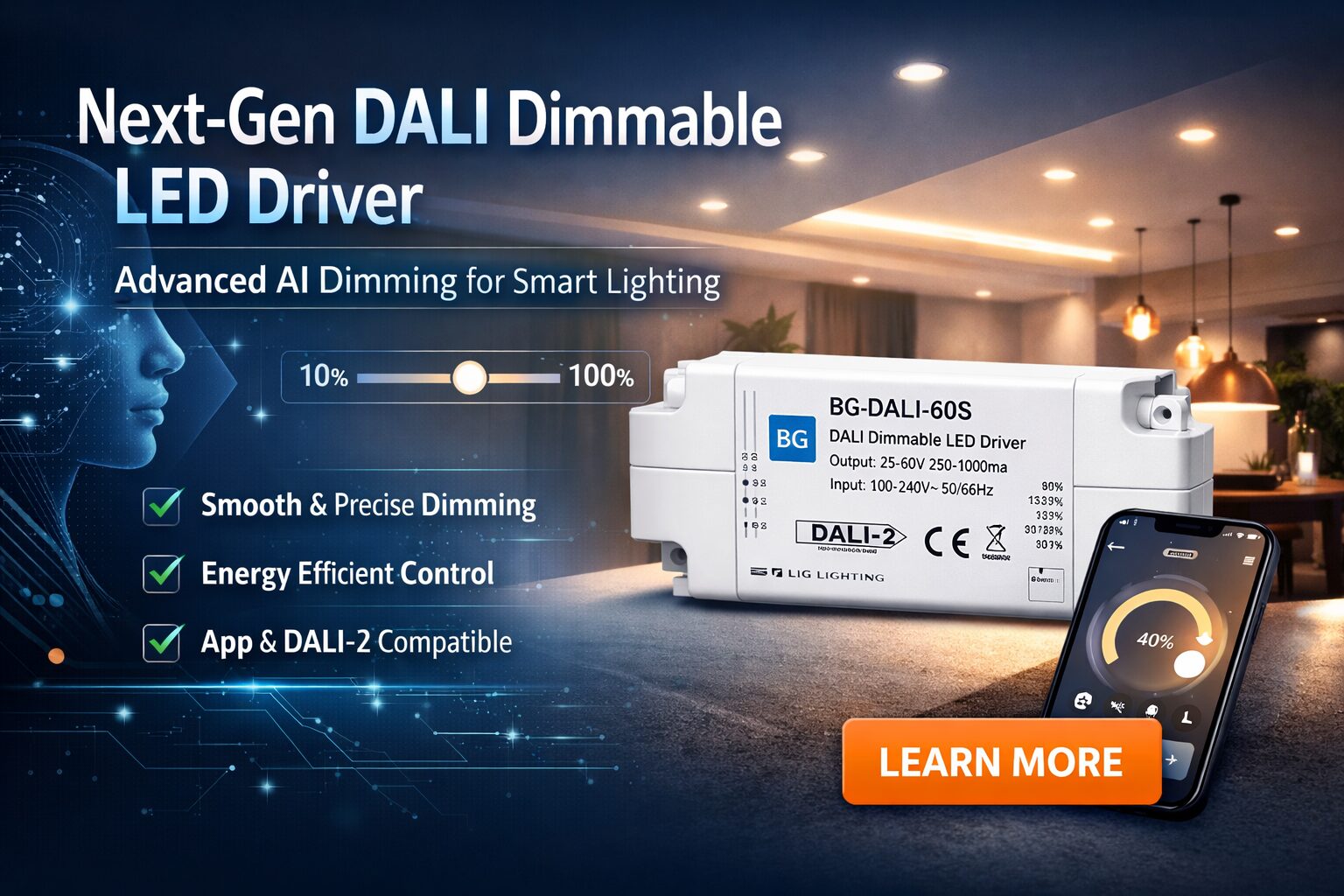
Leading AI-Dimming DALI Driver Brands and Products
The market for DALI-2 certified drivers with AI-enhanced dimming capabilities is growing rapidly. Some of the key manufacturers and product lines worth researching for home automation projects include Tridonic (their DALI-2 ready series), Helvar (Imagine AI-powered lighting control), Casambi (Bluetooth Mesh over DALI), eldoLED (renowned for precision dimming performance), and MEAN WELL (cost-effective DALI-2 drivers for budget-conscious integrators).
When evaluating products, always request DALI-2 certification documentation, check dimming curve specifications, verify the warranty period (typically 5 years for quality drivers), and confirm gateway or API availability if you plan to integrate with a third-party home automation system.
The Future of AI-Dimming DALI Technology in Smart Homes
The trajectory of AI-dimming DALI technology is pointing toward even deeper intelligence and integration. Emerging developments to watch include edge AI processing directly within the driver firmware, enabling faster response times and offline operation without cloud dependency. Integration with smart energy grids and demand-response programs will allow AI DALI systems to automatically dim or shift load during peak tariff periods, generating savings that go beyond simple occupancy management.
The DALI Alliance is actively developing new DALI-2 application controller types that will expand the protocol’s native support for wireless mesh topologies, color tunable LED control (already addressed in DALI Part 209), and enhanced diagnostics. In parallel, manufacturers are embedding AI cameras and radar sensors directly into luminaires, feeding richer data to DALI drivers for even more nuanced behavioral learning.
For homeowners investing in smart home infrastructure today, choosing an AI-dimming DALI driver system is one of the most future-proof decisions available. The open standard, the strong certification ecosystem, and the growing AI layer mean that your investment today will continue to deliver value and receive software enhancements for years to come.
Conclusion: Is an AI-Dimming DALI Driver Right for Your Home?
If you are serious about building a smart home that genuinely works with you rather than simply responding to commands, an AI-dimming DALI driver system is one of the most impactful investments you can make. It combines the reliability and openness of a proven industrial standard with the adaptability and intelligence of modern machine learning — delivering lighting that is energy-efficient, healthy, convenient, and beautiful.
Whether you are a first-time smart home buyer looking for an upgrade, a self-builder designing your dream home, or a professional integrator advising clients, DALI-2 certified AI-dimming drivers represent the state of the art in residential lighting control. Invest in the right hardware, work with a certified lighting control specialist, and you will enjoy a lighting system that pays for itself in energy savings while making every day at home more comfortable and connected.