

How to Choose the Right DALI Driver for LED Lights
When it comes to intelligent LED lighting control, DALI — Digital Addressable Lighting Interface — has become the global standard of choice for commercial, industrial, and architectural installations. Unlike simple on/off switching or analog 0-10V dimming, DALI offers granular, addressable, two-way communication between a lighting controller and each individual driver on the network. But with so many DALI drivers on the market, specifying the right one for your project can feel overwhelming.
This guide walks you through everything you need to know: what DALI actually is, the critical specifications to compare, the most common driver types, and a step-by-step decision framework to match the right driver to your LED lighting application — whether you are designing a large office complex, a retail showroom, or a smart home installation.
What Is a DALI Driver and How Does DALI Work?
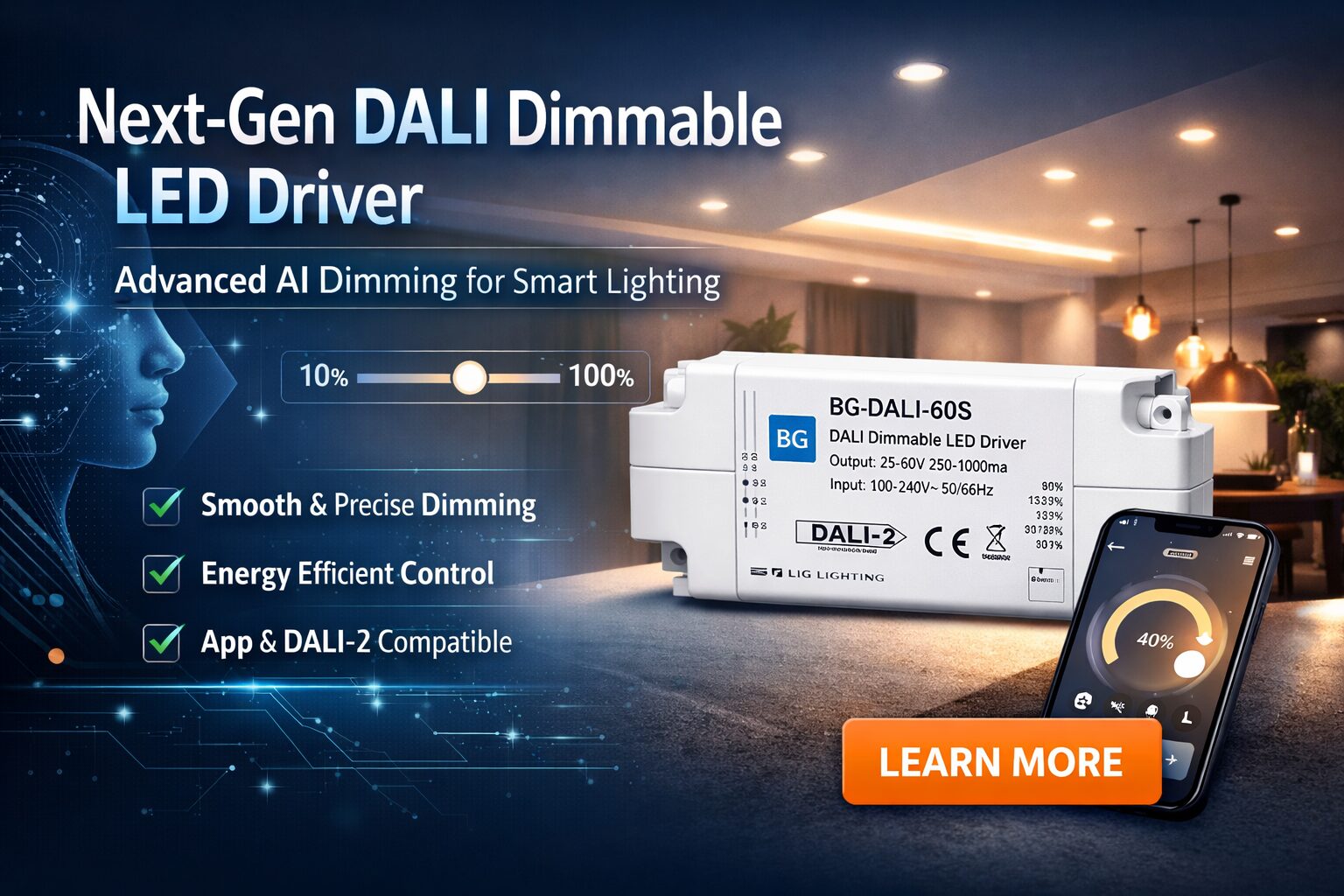
A DALI driver is a power supply unit that sits between your mains AC power source and your LED luminaire, converting high-voltage AC to the controlled DC current that LEDs require. What makes a DALI driver different from a standard LED driver is its built-in microcontroller that can receive and respond to digital commands over a two-wire bus.
The DALI protocol — standardised under IEC 62386 — uses a simple two-wire low-voltage bus (typically 16V DC, up to 250mA) alongside the existing power wiring. Up to 64 individual devices, or 64 groups, can be addressed on a single DALI bus. Each device stores its own settings, dimming curves, fade times, and scene configurations in non-volatile memory, meaning the lighting setup is preserved even after a power cut.
Because DALI is a two-way protocol, the controller can also query each driver for status information: is the lamp operating? What is the current dim level? Has a fault been detected? This bidirectional feedback loop is the key advantage that separates DALI from simpler dimming solutions and makes it essential for energy-managed buildings that need audit trails and fault reporting.
Key Insight: DALI is not a proprietary system — it is an open international standard. Compliant devices from different manufacturers are fully interoperable, giving you complete freedom to mix and match hardware from the best suppliers for each part of your project.
DALI Versions: DALI-1 vs DALI-2 — What Is the Difference?
Before selecting any driver, it is essential to understand which version of the DALI standard applies to your project. There are two generations currently in use:
DALI-1 (Original Standard)
The original DALI specification covered the basic command set for LED drivers, fluorescent ballasts, and a handful of other device types. While functional, DALI-1 lacked mandatory testing and certification requirements, which occasionally led to interoperability issues between different brands.
DALI-2 (IEC 62386 Edition 2 and Beyond)
DALI-2 is the current standard and introduces mandatory third-party testing and certification for all compliant products. It also significantly expands device type support, adds dedicated input device types (push buttons, occupancy sensors, light sensors), and introduces new control gear types including Part 209 for colour tunable luminaires and Part 251 for complete LED modules with integrated drivers.
For any new installation, always specify DALI-2 certified drivers. Not only does this guarantee interoperability, but DALI-2 certified products carry the official DALI-2 logo from the DALI Alliance — the industry body that manages certification testing.
Recommendation: Request the DALI Alliance certification number from your supplier and verify it on the official DALI Alliance product database before procurement.
The 7 Critical Specifications to Evaluate When Choosing a DALI Driver
Selecting a DALI driver is not just about picking a DALI-compatible product off a shelf. The following specifications will directly determine whether the driver performs correctly in your application:
1. Output Current and Power Range
LED drivers are constant-current devices, meaning they deliver a fixed current (measured in milliamps, mA) regardless of small changes in load voltage. Always match the driver’s output current to the LED module’s rated current. If the LED requires 700mA at 24-48V, you need a driver rated for exactly that range. Many DALI drivers offer adjustable output current — often set via DIP switches or DALI commands — allowing one SKU to serve multiple LED variants. Check the minimum and maximum output current range and ensure your LED sits comfortably within it.
2. Output Voltage Range
Constant-current drivers operate within a voltage window rather than a fixed voltage. A driver rated 15-55V DC output will work with any series LED string whose forward voltage at the rated current falls within that window. If your LED load voltage falls outside the driver’s output voltage range, the driver will either fail to regulate correctly or not start at all. Always confirm the LED’s Vf (forward voltage) at the operating current against the driver’s output voltage specification.
3. Dimming Range and Performance
One of the most scrutinised specifications in architectural and hospitality lighting is the dimming range. The DALI standard supports 256 arc-power levels logarithmically mapped to represent perceived brightness. However, the actual minimum dim level a driver can achieve varies considerably between products — from 10% down to as low as 0.1% for premium theatrical-grade drivers. Poor-quality drivers may exhibit visible flicker, colour shift at low levels, or audible buzz from the LED module at the lower end of their dimming range.
Always test drivers at their claimed minimum dim level with your specific LED module before specifying in large quantities. Flicker performance is especially critical in environments with cameras or screens — look for drivers tested to IEEE 1789 or with a Flicker Index below 0.1 across the dimming range.
4. IP Rating and Thermal Performance
The Ingress Protection (IP) rating tells you how well the driver is sealed against dust and moisture. For indoor dry locations, IP20 is standard. Outdoor or wet area applications require at least IP65 (dust-tight, protected against water jets) or IP67/IP68 for submerged or temporarily flooded environments. Equally important is the driver’s operating temperature range and thermal management. DALI drivers generate heat during operation, and a driver mounted in a sealed ceiling void or an outdoor enclosure without adequate thermal path will have its lifetime significantly reduced. Check the Tc (case temperature) rating and the maximum allowable ambient temperature (Ta).
5. Power Factor and Efficiency
Commercial and industrial projects increasingly require high power factor (PF > 0.9) and high efficiency to comply with building regulations and energy codes such as ASHRAE 90.1 or Part L in the UK. A driver with a power factor of 0.5 draws twice the apparent current for the same real power output, which wastes capacity on upstream wiring and switchgear. Look for DALI drivers rated PF > 0.95 and efficiency above 90% at full load for best results.
6. DALI Device Type and Part Number
Under IEC 62386, different types of control gear are defined as separate parts — Part 207 for LED drivers, Part 209 for colour temperature tunable (CCT) drivers, Part 218 for drivers with dim-to-warm functionality, and so on. Ensure the driver you select is certified under the correct part number for your application. A standard single-channel DALI-2 LED driver will be certified to Part 207, while a dual-channel tunable white driver controlling warm and cool LED channels separately will be certified to Part 209.
7. Emergency Lighting Integration
If your project requires maintained or non-maintained emergency lighting, look for DALI drivers with integrated emergency function — known as DALI EM (IEC 62386 Part 202). These drivers incorporate a battery, battery management, and emergency test reporting all within a single unit, eliminating separate emergency conversion kits. DALI EM drivers can be addressed and tested remotely via the DALI bus, and can report test results and battery status back to the building management system automatically.
Types of DALI Drivers: Which Format Suits Your Project?
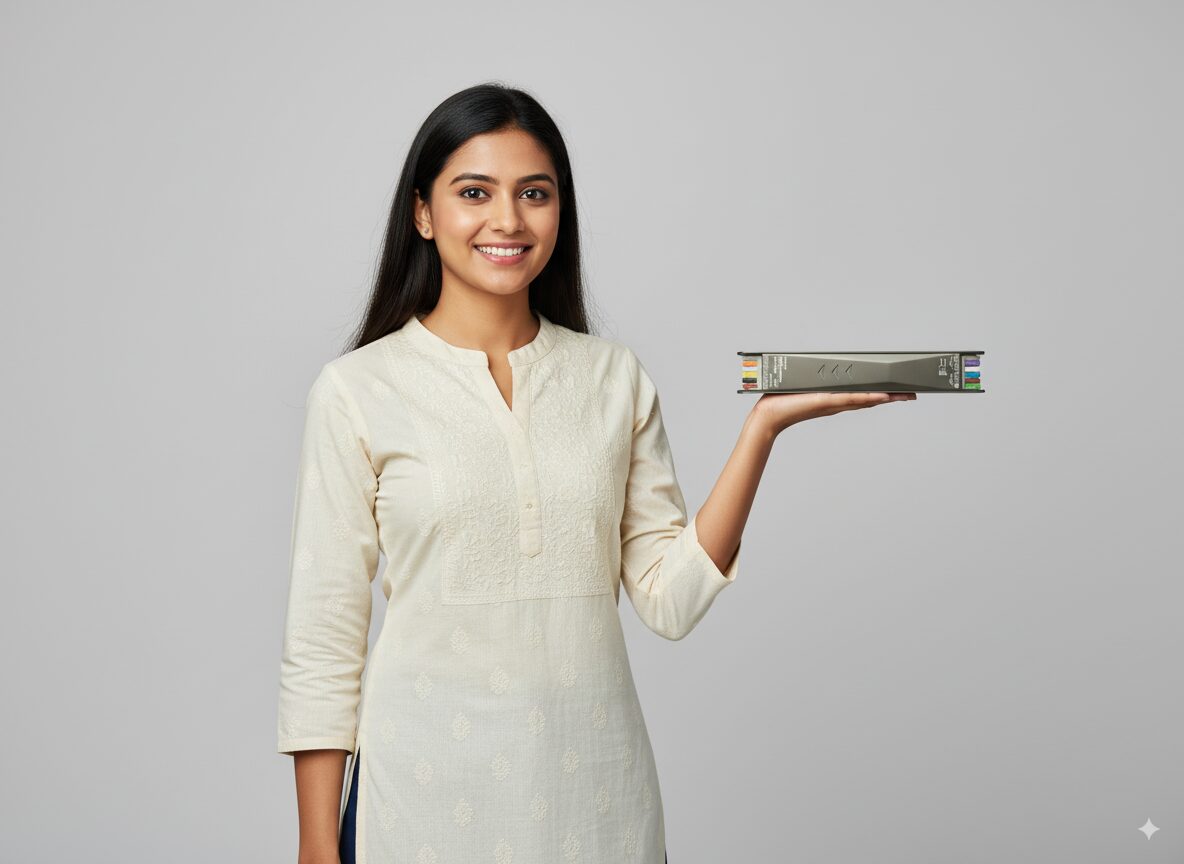
DALI drivers come in several physical formats, each suited to different luminaire types and installation methods:
Fixed Output DIN Rail Drivers
Designed for installation inside control panels or electrical enclosures, DIN rail DALI drivers are commonly used in commercial office, retail, and industrial projects where centralised distribution is preferred. They power multiple luminaires wired in parallel and typically offer outputs from 25W to 200W.
Constant-Current LED Module Drivers
The most common format for architectural and specification-grade luminaires, these compact drivers are housed in an oval or rectangular metal case and mounted inside or adjacent to the luminaire body. Output currents from 350mA to 1050mA suit most commercial LED modules, with higher current versions available for high-lumen industrial fittings.
Plug-and-Play DALI Retrofit Drivers
For retrofit projects converting existing fluorescent fittings to LED, plug-and-play DALI drivers with Zhaga-compliant connectors allow tool-free replacement of conventional drivers while retaining full DALI addressability and dimming on the existing wiring infrastructure.
Multichannel and RGB/RGBW DALI Drivers
For dynamic colour-changing applications — hospitality, entertainment, retail feature lighting — multichannel DALI drivers control separate red, green, blue, and sometimes white LED channels independently. These are typically certified to IEC 62386 Part 209 (colour) and Part 262 (Colour Type 8 — DT8) and require a colour-capable DALI controller to unlock their full feature set.
Step-by-Step Guide to Choosing the Right DALI Driver
Follow this structured decision process to narrow down the right driver for your project:
- Define your LED load. Document the LED module’s rated current (mA), forward voltage (V), and wattage for each circuit.
- Identify the application requirements. Does the project require colour tuning, emergency lighting, scene setting, daylight harvesting, or occupancy control? This determines the DALI part type needed.
- Determine the environment. Indoor dry, outdoor, wet area, or hazardous location will dictate the IP rating and housing material required.
- Check the DALI system architecture. Confirm how many DALI buses the controller supports, the maximum number of addressable devices per bus, and whether the system uses DALI-1 or DALI-2 protocol.
- Shortlist DALI-2 certified drivers. Use the DALI Alliance product database to verify certification. Cross-reference output current, voltage range, minimum dim level, efficiency, and thermal ratings against your LED load.
- Test before you specify. Request samples and commission a mock-up or lab test with your specific LED module at both full brightness and minimum dim level. Verify flicker, colour consistency, and heat generation.
- Confirm lead times and availability. DALI drivers from premium brands often have longer lead times. Secure supply chain commitments early in the project programme to avoid delays.
Common Mistakes to Avoid When Specifying DALI Drivers
Even experienced lighting designers occasionally fall into these traps:
- Mixing DALI-1 and DALI-2 devices on the same bus. While mostly backward-compatible, some advanced DALI-2 commands will not function correctly with older DALI-1 devices.
- Overloading a DALI bus beyond 64 addresses. Devices beyond the limit will not be addressable. Use a DALI repeater or additional bus if the device count exceeds the limit.
- Ignoring bus current limits. The DALI bus power supply is typically limited to 250mA. Calculate the bus current consumption of all connected devices and ensure it does not exceed this threshold.
- Specifying a driver without verifying the minimum dim level. A driver advertised as ‘dimmable to 1%’ may achieve this only with specific LED modules. Always test with your actual LED product.
- Assuming all DALI controllers support all device types. Some budget DALI controllers only support standard on/off and basic dimming (Part 207) and cannot control colour tunable (Part 209) or DT8 colour devices.
- Neglecting surge protection. In large commercial installations, particularly where cables run through exposed external routes, DALI drivers should include or be paired with surge protection devices rated to IEC 61000-4-5 Level 3 or above.
DALI Driver Comparison: Key Brands and What to Look For
Several manufacturers dominate the professional DALI driver market, each with distinct strengths. When evaluating brands, look beyond marketing materials and focus on the following factors:
- DALI Alliance certification status and whether products are listed on the official database — not just self-declared compliant.
- Third-party photometric and flicker testing data, ideally from accredited laboratories such as TÜV, Intertek, or UL.
- Quality of technical documentation — datasheets should clearly state output current tolerance (typically ±5%), DALI device type, and lifetime (L70) at rated Tc temperature.
- Availability of configuration software or mobile apps for pre-programming and commissioning support.
- Warranty terms and after-sales technical support, particularly important for projects with long design-to-completion timelines.
Future-Proofing: DALI-2 and the Path to Wireless and IoT Integration
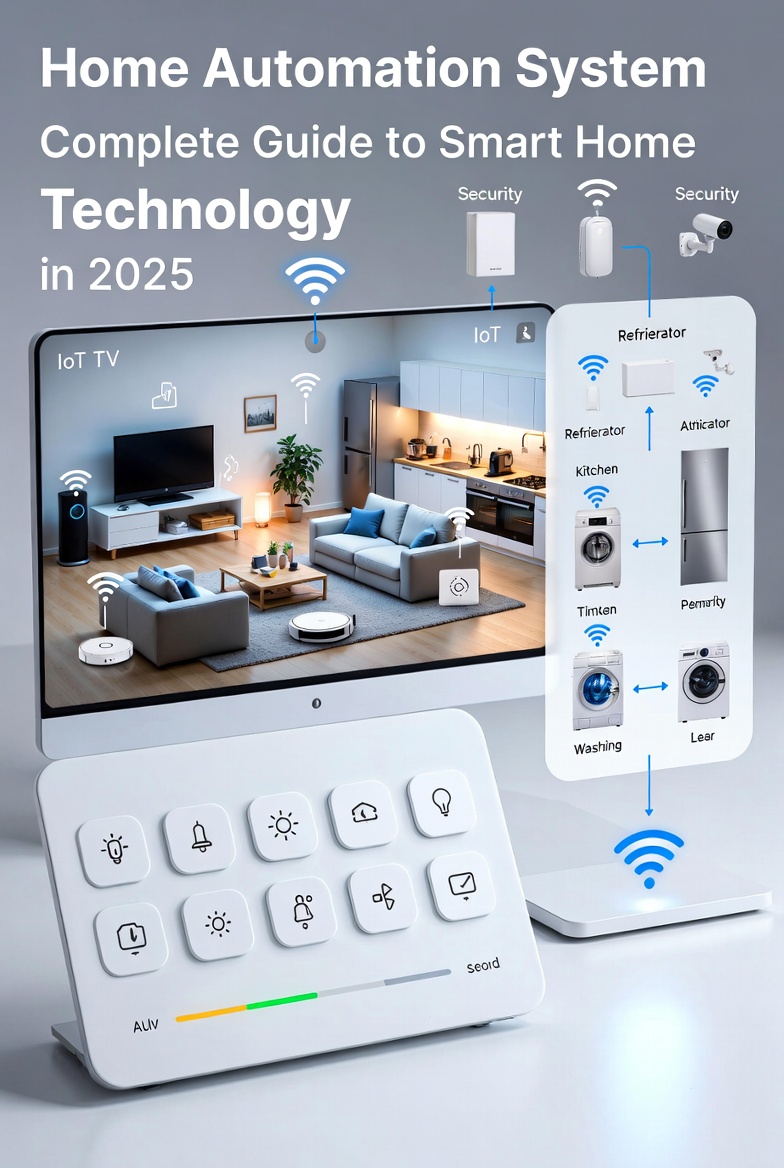
The DALI ecosystem continues to evolve. The DALI Alliance has published specifications for wireless DALI (DALI+), allowing DALI commands to be transmitted over Zigbee, Bluetooth Mesh, or Wi-Fi networks alongside the traditional wired bus. For forward-thinking projects, specifying DALI-2 drivers that can work with wireless gateway devices ensures the lighting infrastructure can be upgraded to cloud-connected smart building systems without replacing the drivers themselves.
Building Information Modelling (BIM) integration is also increasingly important. Leading DALI driver manufacturers now publish BIM objects (Revit families, IFC files) for their products, enabling accurate specification and coordination within digital project workflows.
Power over Ethernet (PoE) is another technology gaining traction in intelligent building applications, though for high-power LED fixtures above approximately 90W, DALI over traditional wiring remains the more practical and cost-effective solution.
Looking Ahead: When writing specifications for projects with completion dates 18 months or more in the future, include language requiring DALI-2 certification and IEC 62386 compliance to future-proof against rapid product evolution.
Conclusion: A Systematic Approach Delivers the Best Results
Choosing the right DALI driver for LED lights is not a decision to be made on cost alone. A driver that fails to meet the minimum dim level requirement, generates flicker at low levels, or lacks proper certification will compromise the entire lighting scheme — regardless of how well every other element has been designed. The additional investment of time to verify specifications, request samples, and confirm DALI-2 certification pays back many times over in a system that commissions cleanly, delivers the promised visual quality, and meets the building’s energy performance targets.
Start with the LED load, work through the environment and control requirements systematically, verify every specification against the DALI Alliance database, and test before you commit to large-scale procurement. Follow this process consistently and you will select a DALI driver that performs exactly as designed — day one and for the lifetime of the installation.
Can I use a DALI driver without a DALI controller?
Yes. DALI drivers retain their last programmed state if the DALI bus is unpowered or disconnected. Many drivers also include a manual override or power-line switching input for simple on/off control without DALI commands. However, to access scene control, dimming, and addressability, a DALI controller or gateway is required.
How many DALI drivers can I connect to one bus?
A single DALI bus supports up to 64 individually addressable control gear devices (drivers). These can also be organised into up to 16 groups, and up to 16 scenes can be stored per device. If your project requires more than 64 drivers in a single zone, you will need multiple DALI buses, each with its own controller or a multichannel controller that manages several buses simultaneously.
Is DALI compatible with Casambi, KNX, or BACnet building management systems?
DALI is widely integrated with third-party building management and smart lighting systems via gateway devices. Casambi gateways can translate Bluetooth Mesh commands to DALI. KNX-DALI gateways are standard products from numerous manufacturers. BACnet integration is available via IP-DALI gateways, enabling full integration with building automation systems for energy reporting and centralised control.
What is the difference between DALI and 0-10V dimming?
0-10V is an analogue dimming protocol using a variable DC voltage (0V to 10V) to set the dim level. It is simpler and lower cost, but offers no addressability, no feedback, and limited dimming resolution. DALI is a digital protocol supporting individual addressing, two-way communication, scene storage, and fault reporting. For commercial projects where control sophistication and energy management are priorities, DALI is the superior choice despite its higher initial cost.